You don’t have to climb Venice to understand it, but descend it. In Venice, the
“Scala Contarini del Bovolo” is a spiral that rises towards the sky to lead
you down into the secret heart of the city, where the real Venice is not admired, but
listened to.
The narrative of the “hidden gem” no longer convinces us.
In the era of digital saturation and hyper-tourism,
the concept of truly “hidden” places is almost mythical. False.
I wonder then if the relative “elusive” aura of the Scala del Bovolo is accidental.
I propose instead that it is a form of intentional discretion. Venice,
historically and still today, is a city of secrets, of subtly revealed beauty
and layered experiences. The Scala is not “hidden” in the sense of being almost
“inferior,” but rather intricately connected to the urban fabric. Finding it
requires a deliberate act of research and discovery.
This discretion adds charm, offering a more authentic and less commodified
experience compared to the great iconic attractions advertised on social media.
Venice. Faded postcard for hurried tourists? Or a vibrant, layered, pulsating
soul beneath the sparkling surface of the most famous canals? The answer, then,
whispered among the less traveled streets, is complex, elusive, authentic. And it
materializes, unexpectedly, in a corner of sky captured in the stone spiral: the
“Scala Contarini del Bovolo”.
Not a simple monument, not a mere attraction. The Scala Bovolo is a key. A key
to decipher the enigma of Venice, to penetrate its pulsating heart, to understand its
intimate essence.
It is a conceptualization of ascent, an architectural manifesto carved in Istrian
stone, that speaks to us of ambition, perspective, and a Venice that resists time
and trivialization. A clear example of that authentic, silent greatness that is
revealed to those who know how to look beyond the surface.
The Ascent as a Venetian Metaphor: From the Lagoon Level to the Open Sky
Venice, a horizontal city. Spread out on the water, enveloped in its liquid embrace,
it seems to deny verticality. Its foundations sink into the mud, its expansion
unfolds laterally, in a labyrinth of streets and squares.
Yet, in the heart of this apparently flat city, beats an irrepressible desire for
elevation.
A yearning for height that manifests itself in the Gothic spires, the soaring
bell towers, the domes that defy gravity. St. Mark’s, with its Byzantine basilica
and its bell tower pointing to the sky, is the most striking example of this
vertical tension.
But the Scala Bovolo, more intimate, more discreet, embodies this
aspiration in an even more subtle, more human way.
Its spiral is an upward movement that breaks the horizontal linearity of Venice. It
is an invitation to rise, to detach from sea level, to seek a privileged point of
view. Not only physical, but also metaphorical. Ascent becomes a symbol of
ambition, intellectual elevation, spiritual search.
A path that leads from the ground to the sky, from the concrete to the abstract, from
the particular to the universal.
But is it just a staircase, after all?
A mere functional architectural element? Or does it contain a deeper meaning, an echo
of the Venetian soul that aspires to infinity?
Bòvolo: The Snail of Time – Organic Growth and Venetian Patience
“Bovolo“. A dialect term, sweet and round like the shape it designates. Snail,
spiral, shell. But why call a staircase that?
It is not just a descriptive matter, a simple formal analogy. “Bovolo” is a word
laden with latent meanings, which resonate deeply with the essence of Venice.
The snail is a symbol of slow, organic, patient growth. A constant, but gradual
movement that develops over time. And Venice, is it not also the result of a
slow and patient growth?
Built brick by brick, foundation upon foundation, over the centuries, snatching space
from the lagoon, adapting to its changing conditions.
The Bovolo spiral recalls cyclic time, continuous movement, the
interconnection of levels. Just as the snail builds its shell gradually, so
Venice has built itself over time, layering history and culture. An
organic process, non-linear, that reflects the complexity and
richness of the city.
In a frenetic world, dominated by speed and immediacy, Venice and its Scala Bovolo
remind us of the value of slowness, patience, organic growth.
They resist haste, superficiality, standardization. Like the snail that retreats
into its shell to protect itself, Venice preserves its identity, its authenticity,
its deep soul.
But how does this stone snail, silent and discreet, contain the spirit of Venice?
What is the secret kept in its spiral?
Architecture of Ascent: Fusion of Styles, Synthesis of Venetian Identity
The Scala Bovolo is not a monolithic, unequivocal architectural work. It is a
palimpsest of styles, a dialogue between different eras, a symphony of influences.
Renaissance, Gothic, Venetian-Byzantine.
A fusion that is not accidental, not a mere decorative eclecticism. It is a
language. The architectural language of Venice.
The Gothic, slender and light, recalls verticality, the aspiration to the sky.
The Renaissance, harmonious and proportioned, celebrates man and his
centrality. The Venetian-Byzantine influence, rich in decorations and oriental
suggestions, recalls Venice’s mercantile and cosmopolitan past, its role as a
bridge between East and West.
This fusion of styles is not just an aesthetic matter. It is a metaphor for the same
Venetian identity, complex, layered, multicultural. Venice has been a
crossroads of peoples, ideas, goods. It has assimilated, reinterpreted, synthesized
different influences, creating something unique, unrepeatable.
The Scala del Bovolo, in this sense, is a microcosm of Venetian architecture.
A compendium of styles that merge into a single work, creating a surprising harmony.
Not a simple juxtaposition, but a true synthesis. Like Venice itself, which has
transformed diversity into wealth, complexity into beauty.
And does this architectural ascent, this layering of styles, perhaps also reflect a
social, cultural ascent? A path of evolution and transformation that has shaped the
soul of Venice?
Ascent to Perspective: The View from the Bovolo, Panoramic Understanding of Venice
Climbing the Scala Bovolo is not just a physical exercise, a simple climb. It is a
journey. A path that winds in a spiral, gradually leading upwards, towards a
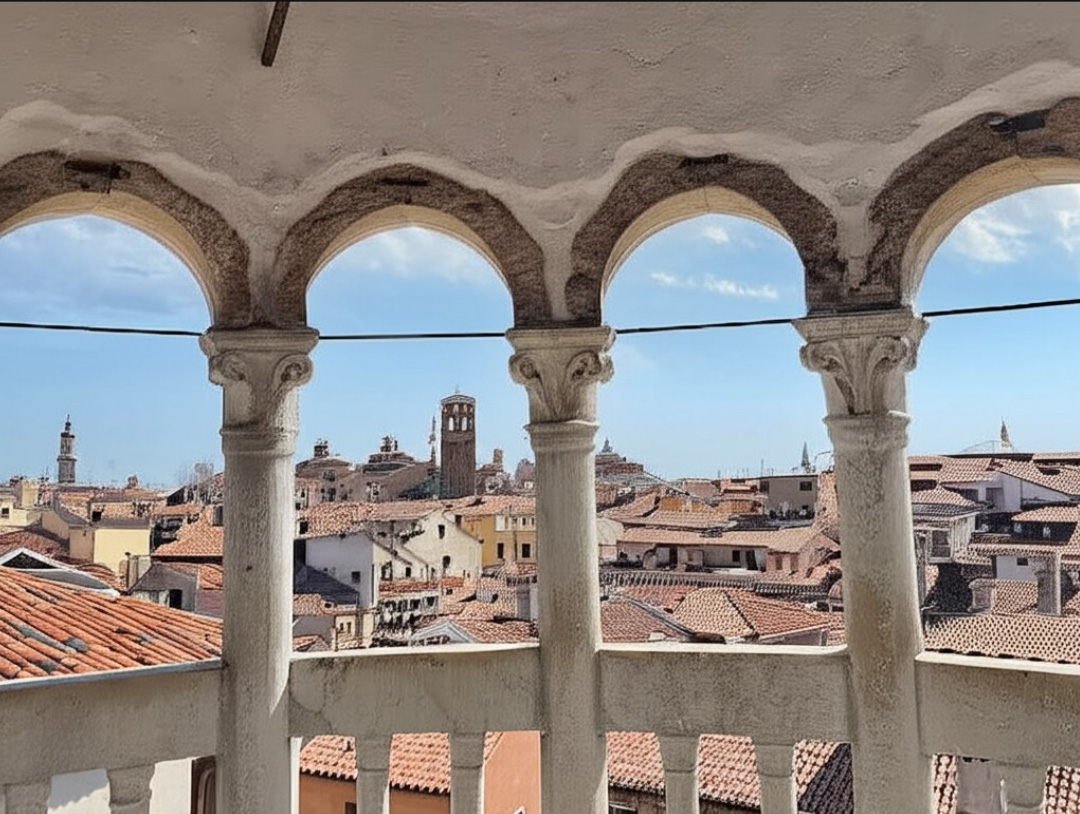
new perspective. And once you reach the top, the reward is immense: a breathtaking
panoramic view of Venice.
Not the postcard Venice, the one of the crowded grand canals and iconic monuments.
But a more intimate, more secret, more authentic Venice.
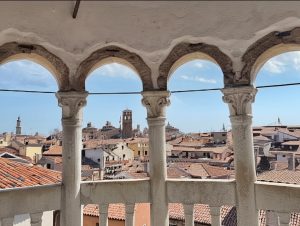
From the top of the Bovolo, you can embrace the urban fabric with a gaze, the
intricate pattern of streets and squares, the red roofs that stretch as far as the
eye can see, the domes that emerge like islands in the sea of tiles.
An unprecedented perspective, which reveals the complexity and harmony of the
Venetian urban fabric. One perceives its organic nature, its spontaneous growth, its
adaptation to the lagoon context. One understands its proportions, its distances, its
spatial relationships. An open-air urban planning lesson.
But the view from the Bovolo is not just a pleasure for the eyes, an aesthetic
satisfaction. It is also an intellectual, emotional experience. Physical
ascent transforms into intellectual ascent, into emotional elevation. One gains a new
perspective not only on Venice, but also on oneself, on one’s place in the world.
Can a staircase really offer a new way of seeing?
Can it transform our perception, broaden our horizons, enrich our understanding?
The answer, whispered by the wind that caresses the top of the Bovolo, is an
unequivocal yes.
Authentic Venice in Detail: Beyond the Grand Canal, the Intimate Greatness of the
Bovolo
Venice, often reduced to a tourist icon, a picturesque backdrop for selfies and
souvenirs. The Grand Canal, Piazza San Marco, the Rialto Bridge. Magnificent places,
of course, but often overcrowded, distorted by the crowds and consumerism. Where to
find, then, the
authentic Venice?
Not in the most obvious, most celebrated places. But in the details, in the
particulars, in the hidden corners, in the less traveled streets. The Scala del
Bovolo is one of these places. Discreet, secluded, almost shy, it is hidden in a
secluded square, away from the clamor of the masses.
Yet, its beauty is extraordinary, its elegance refined, its atmosphere evocative. An
intimate greatness, which is revealed to those who have the patience to seek it, to
discover it, to appreciate it. Not the ostentatious grandeur of the palaces on the
Grand Canal, but a greatness more silent, more interior, more authentic.
The Scala Bovolo is an example of this hidden Venice, of this discreet beauty,
of this resistant authenticity. It reminds us that the true essence of Venice is not
found in tourist clichés, but in its deep soul, in its millennial history, in its
unique culture.
Its image was immortalized in the famous perspective map of Venice created by
Jacopo de Barbari in 1500 and appeared in the film “Othello” by
Orson Welles in 1952. Its presence both in a historical map and in an
internationally renowned film highlights the enduring visual appeal of the Scala
Contarini del Bovolo and its recognition as a significant landmark over time.
But how does this intimate greatness contribute to the “greatness” of Venice? How does
the Scala Contarini del Bovolo, so secluded and silent, embody the authentic soul of
this extraordinary city?
The Social Ascent: From Contarini Residence to Public Treasure, Democratization of
Beauty
The history of the Scala Contarini del Bovolo is also a story of social
evolution, of cultural transformation. Born as a decorative element of a noble
palace, the residence of the Contarini, over time it has become a common good,
a treasure accessible to all.
Built in the 15th century at the behest of Pietro Contarini, the staircase was
intended to enhance the prestige of the family, adding a touch of originality and
magnificence to the residence. A symbol of power, wealth, social distinction. A
private work of art, intended for the gaze of a few privileged people.
But the centuries have transformed the Scala del Bovolo.
In the 19th century, the palace was rented by Arnoldo Marseille, known as the
Maltese, who opened an inn there. It is said that this character
inspired the figure of Corto Maltese, the famous protagonist of the comics by
Hugo Pratt.
The street that leads to the palace is called “Calle delle Locande” and the courtyard
overlooking it “Corte Maltese“, names that may recall the inn activity managed
by Marseille. This literary link adds a veil of romanticism and mystery to the
history of the Scala Contarini del Bovolo, connecting it to a beloved figure of
popular culture.
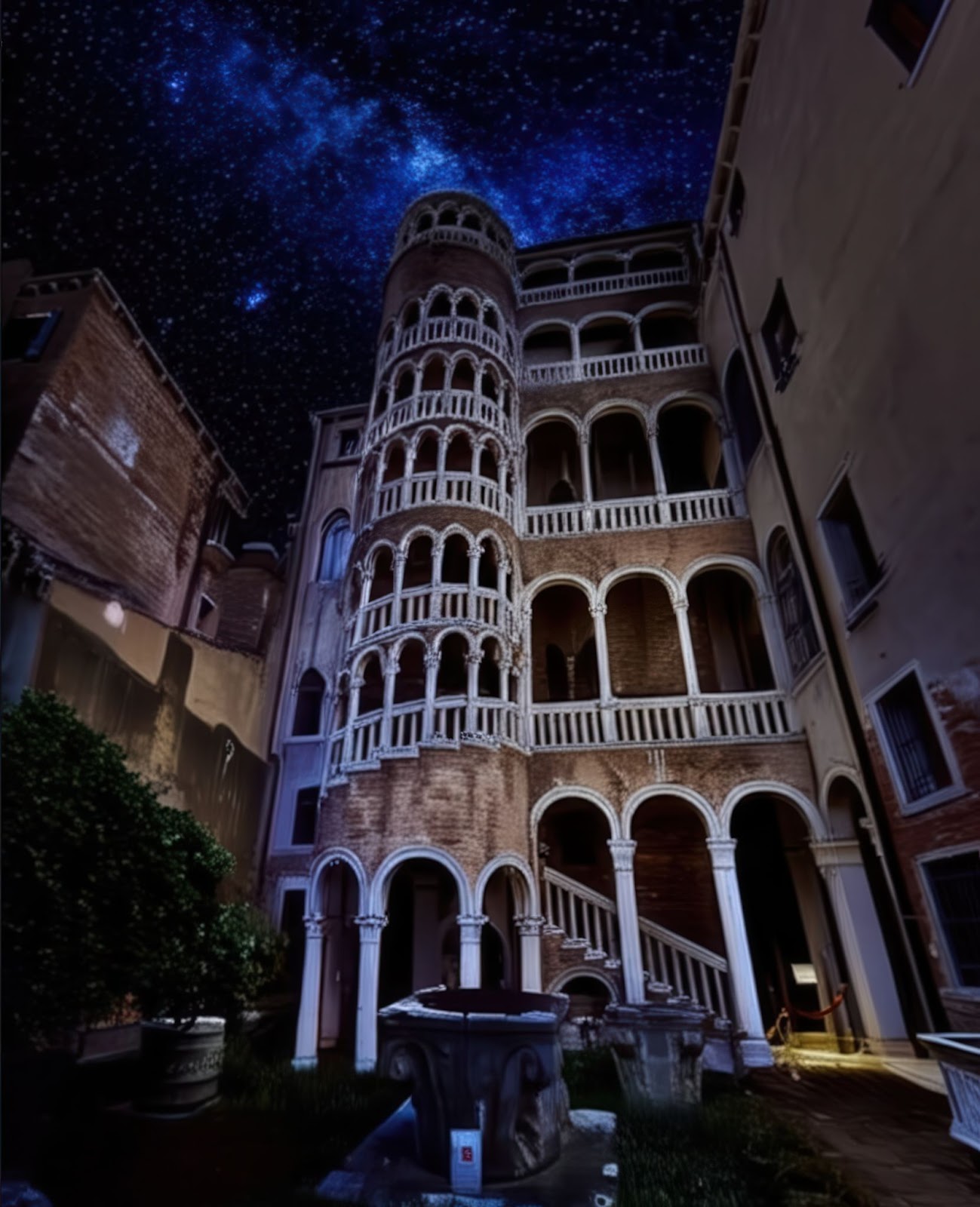
The German astronomer Ernst Wilhelm Tempel made his first astronomical
observations from the top of the staircase in 1859, discovering the comet
C/1859 and the Merope Nebula in the constellation of the Pleiades.
Before belonging to the Contarini, the palace was owned by the Morosini family. Over
the centuries, the building had different uses, including a rental house and a hotel.
In 1849, the last owner donated it to the “Fraterna dei Poveri di San Luca”, and
then it became the administrative headquarters of charitable institutions, first the
Congregation of Charity and later the I.P.A.V.
The staircase was closed to the public for restoration work that began in August 2015,
but it is currently open to visitors. The transformation of the palace from a noble
residence to an inn and then to the seat of welfare institutions reflects the
evolution of the social and economic context of Venice over time.
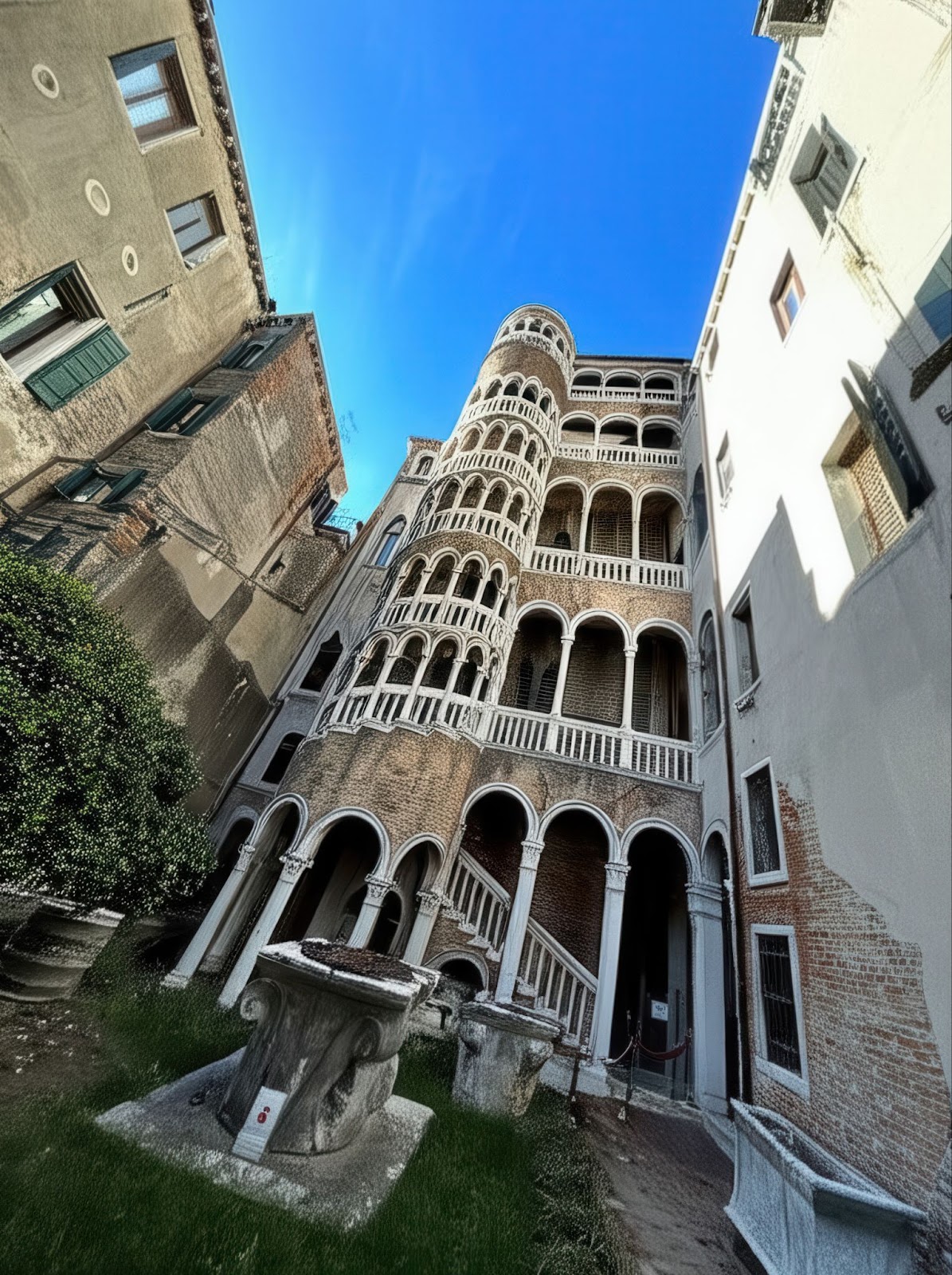
The staircase has eighty monolithic steps that screw counterclockwise. Some sources
mention 113 steps, a discrepancy that may derive from different counting methods.
The structure is spread over four floors 4 or six levels. The staircase appears
light and airy thanks to the presence of arches and reaches a height of almost thirty
meters. Its construction is configured as a cylindrical tower in red bricks,
interspersed with arches and balustrades, made with the use of baked bricks and
Istrian stone. The summit is characterized by a semicircular dome with a belvedere
that offers a panoramic view of the city. The structure includes a portico on the
ground floor that opens onto a small internal garden with well heads and presents
five orders of spiral arches.
The Tintoretto Room: An Overview of the Art Collection
On the second floor of the palace, accessible from the loggia of the staircase, is
the Tintoretto Room. This room displays a collection of Venetian art dating from the
16th to the 18th century. Among the most significant works are a sketch of the
“Paradise” by Jacopo Tintoretto, a portrait of Francesco Guardi and a
sculpture by Jacopo Sansovino. The presence of a sketch by Tintoretto, in
particular for a grandiose work such as the “Paradise” in the Doge’s Palace,
underlines the artistic value of the collection and its link with the great Venetian
masters.
Today, anyone can climb the Scala del Bovolo, admire its architecture, enjoy the
panoramic view. An experience once reserved for a select few, now accessible to all.
A symbol of a Venice that, while preserving its history and traditions, opens itself
to the world, makes itself available, democratizes itself.
This transition, this “social ascent,” is an integral part of the Venetian identity.
A city that, despite having long been dominated by a mercantile oligarchy, has always
cultivated a strong sense of community, a value for the common good, an attention to
the public enjoyment of art and beauty.
Is this democratization of beauty part of Venice’s lasting legacy? How does the Scala
Bovolo, from private to public, reflect Venetian values?
The Timeless Ascent in the Contemporary World
The Scala Bovolo is not just a monument of the past, a historical artifact to be
admired with detachment. It is a living, pulsating work, which continues to speak to
the present, to question us about the future. Its themes – ascent, authenticity,
perspective – resonate strongly in the contemporary world, offering us food for
thought and inspiration.
In an era of superficiality, speed, homogenization, the Scala Bovolo reminds us of
the value of depth, slowness, uniqueness. In a world dominated by pre-packaged
images, tourist clichés, standardized experiences, it invites us to seek
authenticity, truth, essence.
Its spiral, a continuous upward movement, speaks to us of progress, growth,
evolution. But also of cyclicity, of returning to the origins, of respect for the
past. A delicate balance, a fruitful tension, which reflects the complexity of our
time.
The panoramic view from the Bovolo, the privileged perspective it offers on
Venice, invites us to look at the world from a different point of view, to
overcome appearances, to grasp the connections, to understand the relationships. A
fundamental exercise in an era of fragmentation, polarization, loss of meaning.
The Scala Bovolo, in this sense, is a lighthouse. A solid point of reference, in a
sea of uncertainties and changes. A symbol of enduring values, which resist time and
fashions, which continue to illuminate our path.
Can a staircase from the past really guide us towards the future? Can a silent
monument still whisper words of wisdom and inspiration to us? The Scala del Bovolo,
with its timeless spiral, invites us to believe in it.
The Bovolo spiral is an infinite movement, a continuous ascent, an endless
path.
Like the discovery of Venice, a journey that never ends, which is renewed with
every glance, with every step, with every climb. The greatness of Venice, authentic
and profound, unfolds slowly, gradually, like the spiral of the Bovolo, revealing new
perspectives, new emotions, new understandings with each turn.
The Scala Contarini del Bovolo. An invitation to ascent, not only physical, but also
inner.
An authentic, profound, unforgettable Venetian experience. A hidden treasure, which
is revealed to those who know how to seek, to those who know how to climb, to those
who know how to look beyond the horizon.
The address of the Scala Contarini del Bovolo is San Marco 4303, 30124 Venice. It is
located near Campo Manin. To reach it, I recommend identifying Campo Manin and
following the small signs on small wall signs.
If you want to see immediately where the Scala Contarini del Bovolo is, look here:
https://g.co/kgs/tTSAJgH